UNDER TESTING

My Lineage

Find the family you didn't know you had. An Android app for Indian families: enter what you remember about your parents, grandparents, native village and gotra, and My Lineage finds other members who remember the same people, joins your trees, and traces your lineage further back than any one person knows on their own, with per-detail privacy you control.

Android Kotlin Jetpack Compose Supabase · Mumbai PostgreSQL + RLS Matching Engine Google Play Store
▶  Coming soon on Google Play

What is My Lineage?

Most of us know our parents and grandparents. Beyond that, the knowledge is scattered: one great-uncle remembers the village, a cousin in another city has the old photographs, an aunt knows who married whom. Family trees on paper (or in a panda's register) rarely reach the people who need them.

My Lineage puts those pieces together. Every member adds the family they know. When two people describe the same grandfather from the same village, the app notices, shows both sides why, and, once both accept, joins their trees into one, so each family can see relatives and ancestors it never knew about.

🧩
Everyone Holds a Piece

Each person records their parents, grandparents, great-grandparents, spouse, children, siblings, uncles and aunts, plus native village and gotra if they wish.

🌳
Trees That Join Themselves

A matching engine finds the same person described by different families, even with different spellings, and suggests links that both sides confirm.

🔒
Private by Default

Every detail and every photo has its own visibility level. Exact birth time, caste, phone numbers and children's details start hidden from strangers.


Features & Capabilities

A native Android app with five main tabs (Home, Tree, Atlas, Matches and Family), a live shared database, and privacy rules enforced on the server. Built with AI coding assistance and real family data from day one.

🌳
Interactive Family Tree

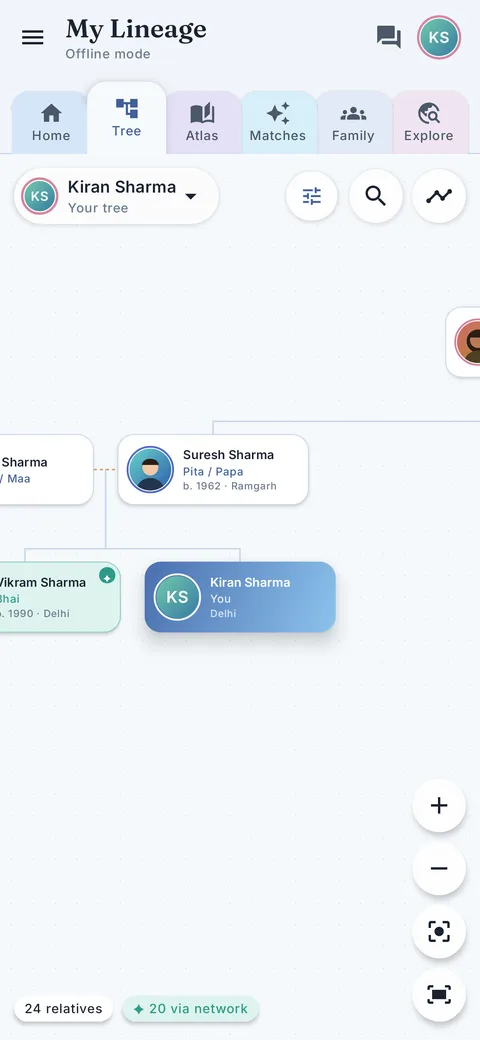
Pinch-zoom tree with photos, generations in rows, father's and mother's sides kept apart, a paternal-line (vansh) view, and relationship names in English and Hindi: Dada, Bua, Mama, Chachera Bhai.

✨
Smart Relative Matching

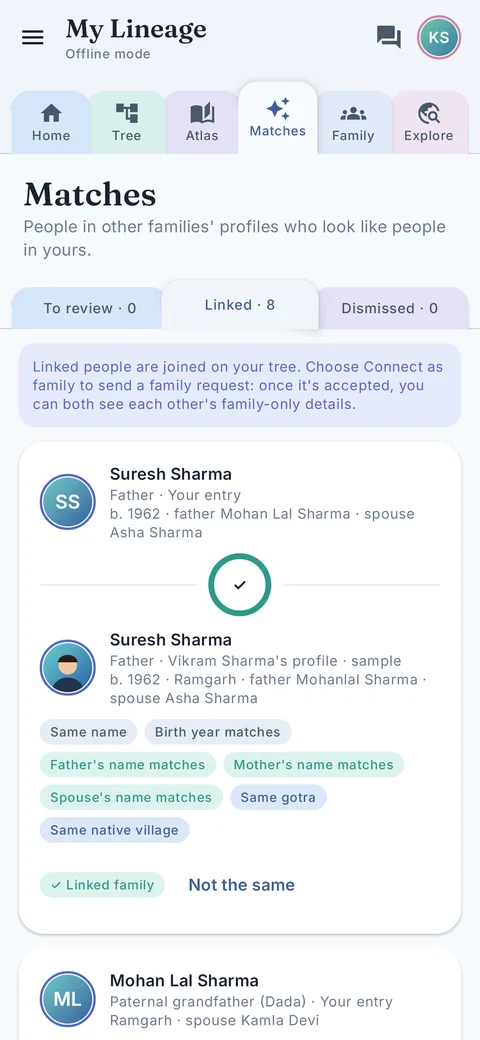
Finds the same person across families even when names are written differently (Mohan Lal / Mohanlal, Sharma / Sarma), and explains every suggestion: names, years, places, parents and gotra that agree.

🗺️
Family Atlas: Six Views

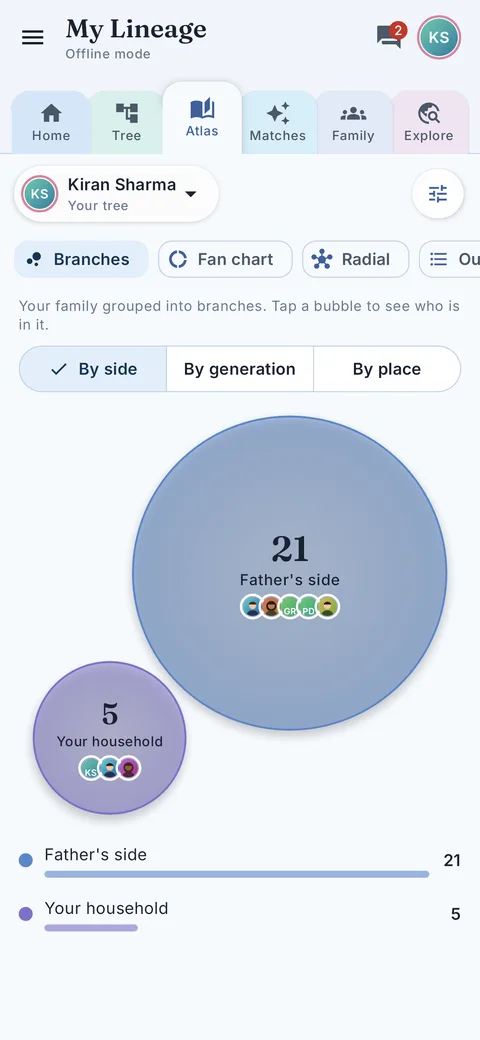
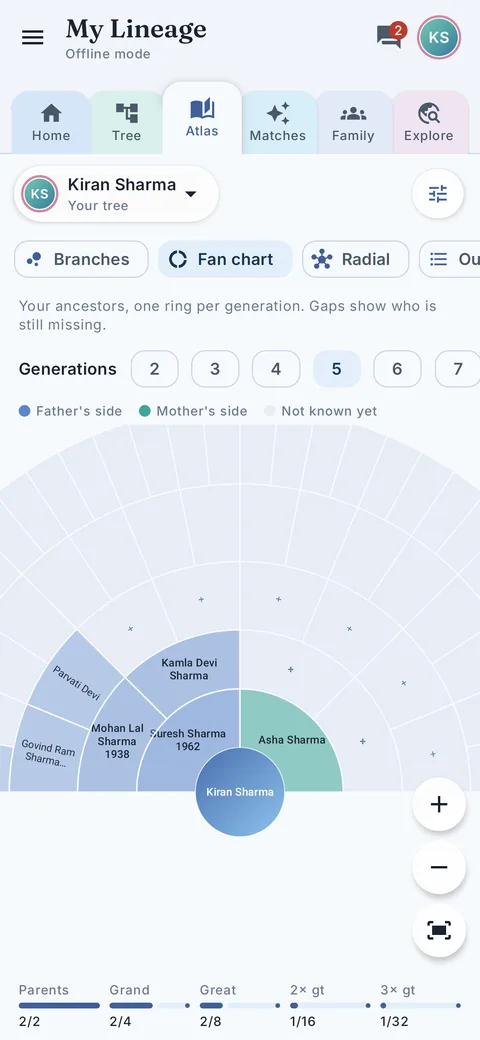
For families too big for one tree: Branches (bubble clusters), Fan chart of ancestors, Radial view, expandable Outline, Relation finder and a birth-year Timeline that flags dates that look wrong.

🔗
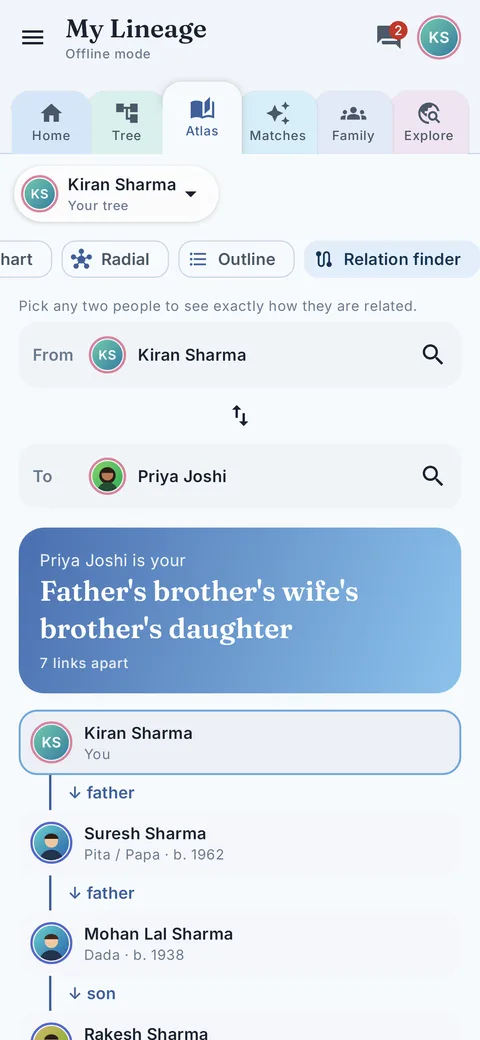
Relation Finder

Pick any two people and see exactly how they are related, link by link: "Vikram is your Chachera Bhai: father → father → son → son".

🎚️
Tree Filters

Show immediate, close or extended family; limit how many generations up and down; show only father's, mother's or spouse's side. Filters apply to the tree and every Atlas view.

📝
Rich Details for Every Relative

Nicknames, full dates of birth, marriage and death, gotra, native village, community, occupation, education, where they live, phone, email and a life story, all optional, each with its own privacy level.

💬
Contact Relatives & Groups

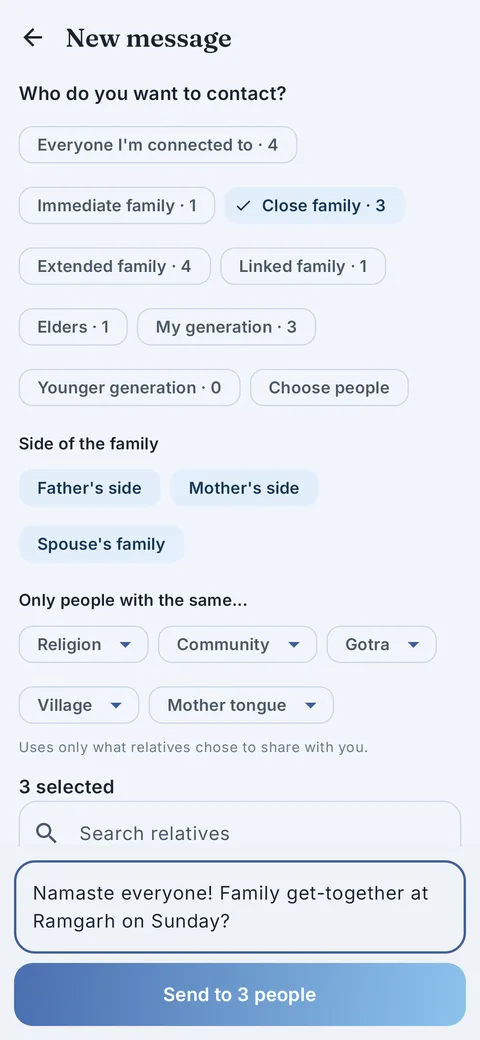
Message one relative or whole groups: a generation, one side of the family, or everyone sharing a gotra, community or village. Call or WhatsApp straight from a relative's card.

🛡️
Per-Detail Privacy

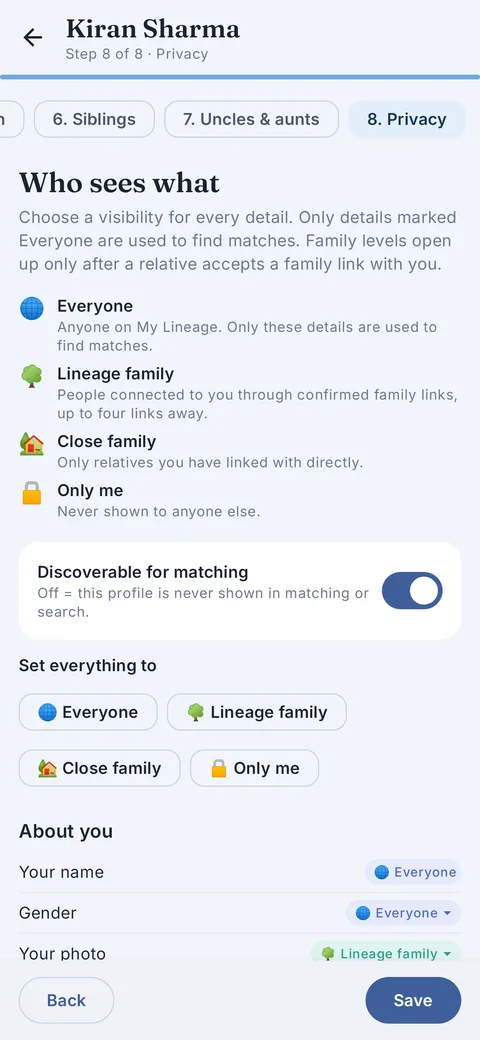
Four levels for every field and photo: Everyone, Lineage family, Close family, Only me. Only details marked Everyone are used for matching. Enforced by row-level security in the database.

📸
Photos on Every Card

Add photos of relatives, compressed to about 50 KB and cached on the phone, so trees load fast on mobile data. Cache is cleared on logout.

🔐
App Lock & Secure Accounts

Email sign-up with verification, password reset, and an app lock that asks for your password or fingerprint each time the app opens, which matters on shared family phones.

🧓
Profiles for Elders

Create and manage a profile on behalf of a grandparent or elder who doesn't use a smartphone. Their memories are often the oldest links in the tree.

🌙
Light / Dark Mode & Accessibility

Calm pastel-blue design with notebook-style tabs, dark mode, a reduce-motion option, large touch targets and a side drawer for profile, settings and developer info.


Screenshots

From the test build, using fictional sample families.

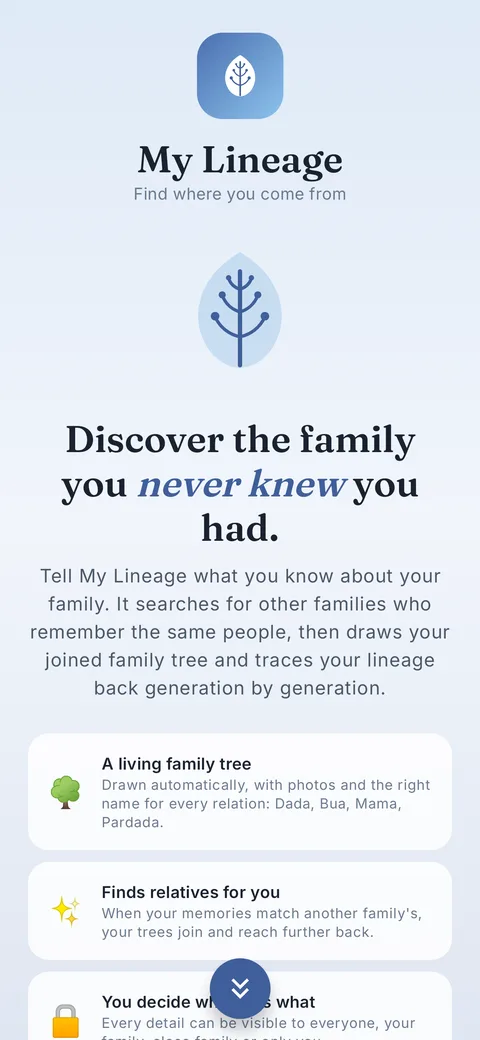
Welcome screen with privacy acceptance
WELCOME & PRIVACY
Family tree view
FAMILY TREE
Suggested relative matches with reasons
MATCHES
Atlas branches view
ATLAS · BRANCHES
Atlas fan chart of ancestors
ATLAS · FAN CHART
Relation finder result
RELATION FINDER
Per-detail privacy settings
WHO SEES WHAT
Contacting family groups
CONTACT GROUPS

The Logic Behind the Matches

Names alone are never enough to join two families. The engine scores every possible pair of people across profiles and only suggests a link when the surrounding family agrees too.

1 · Name Normalisation
// strip titles, fold Indian spelling variants norm("Shri Mohan Lal Sarma") → [mohan, lal, sarm] norm("Late Mohanlal Sharma") → [mohanlal, sarm] // titles removed: Shri, Smt, Late, Swargiya, Dr… // folded: sh→s, bh→b, ph→f, w→v, ee→i, oo→u, // aa→a, doubled letters, final -a
Indian names are written many ways in Devanagari-to-English transliteration. Normalising first means "Sarma" and "Sharma" are compared fairly.
2 · Name Similarity
// Jaro-Winkler on full name, each word, first name nameSim = blend( jw(full_a, full_b), tokenSet(words_a, words_b), jw(first_a, first_b) ) sim("mohan lal sharma", "mohanlal sharma") ≈ 0.97
Token-set matching handles joined and split names ("Mohan Lal" vs "Mohanlal") and different word orders.
3 · Family Context Score
score = name + birth year // ±1 yr strong, >10 yrs = different person + place // birthplace / village + father + mother + spouse names + gotra / native village // only fields marked "Everyone" take part
A "Ramesh, born 1940" is common. A Ramesh born 1940 in Ramgarh whose father was Devi Dutt and whose wife was Kamla is almost certainly the same man.
4 · Safe Merging
if score ≥ 70 → strong match // join if score ≥ 50 → possible match // ask // union-find over all matched pairs // never merge two people from one profile union(a, b) unless same_profile(a, b)
Possible matches are shown to the member with the reasons, and no families are linked until both sides accept the family link.
5 · Kinship Labels
// BFS over parent / child / spouse edges path(you → Vikram) = [U:m, U:m, D:m, D:m] label = "Chachera Bhai" // father's brother's son // Hindi terms: Dada, Nani, Bua, Mausi, Tau, // Chacha, Mama, Bhabhi, Jija, Saala…
Every relationship is computed from the actual chain of links, so labels stay correct however large the joined family becomes.
6 · Date Sanity Checks
// flag improbable parent–child gaps gap = child.birth_year − parent.birth_year if gap < 13 → flag("born too soon after parent") if gap > 65 → flag("unusually large gap")
Shown in the Atlas Timeline as "Worth double-checking". It usually means a mistaken match or a mistyped year.
Who Sees What

Every detail has a default visibility that each member can change. Family-level access only begins when both members accept a family link, and ends the moment either of them unlinks.

Detail Default Used for matching Notes
Name, gender, birth year, birthplace Everyone ✓ Yes The minimum needed for relatives to find each other.
Parents' & grandparents' names Everyone ✓ Yes The strongest signal that two families are the same family.
Gotra, native village Everyone ✓ Yes Can be lowered to family-only at any time.
Children, siblings, relatives' photos Lineage family No Visible to confirmed family up to four links away.
Relatives' full dates, work, education, home, life story Lineage family No Rich history for the family, never for strangers.
Your phone, relatives' phone & email Close family No Only members you have linked with directly.
Exact date & time of birth, caste Only me No Private until you choose otherwise.
Messages Sender & recipient No Group messages are delivered individually, so recipients don't see each other.

Tech Stack

Written from scratch as a native Android app, not a wrapped website, with a Postgres backend where the privacy rules live in the database itself.

🟣
Kotlin 2.2
Native Android app
🎨
Jetpack Compose
Material 3 UI & animation
⚡
Supabase
Auth · DB · Storage · Mumbai
🐘
PostgreSQL + RLS
Server-side privacy rules
🖼️
Coil 3
Photo loading & cache
👆
AndroidX Biometric
Fingerprint app lock
🧪
Robolectric + Roborazzi
Automated UI journeys
▶
Google Play Store
Android distribution

Your Family's Story Belongs to You

A family app only works if families trust it. My Lineage collects only what is needed to connect relatives, shows it only to the people you choose, and never sells it or uses it for advertising.

🎚️
You Choose, Field by Field

Every detail and every photo has its own visibility level: Everyone, Lineage family, Close family or Only me. Only details you mark "Everyone" are ever used to find matches.

🧱
Enforced on the Server

Visibility rules are written into the database as row-level security policies, not just hidden in the app's screens, so they cannot be bypassed by a modified app.

🔑
Secure Accounts

Passwords are stored only as secure hashes by the authentication service. Photos are served through short-lived signed links. The app can ask for your password or fingerprint every time it opens.

🇮🇳
Stored in India

All profiles, photos and messages are stored with Supabase in the Mumbai region and encrypted in transit over HTTPS.

🚫
No Ads, No Tracking

There are no analytics SDKs, no advertising libraries and no usage trackers in the app. It never reads your location, contacts or call logs.

🗑️
You Control Your Data

Export everything you've entered, unlink relatives, block members, or permanently delete your account and all your profiles and photos from Settings, at any time.

🛡️

Our Privacy Commitment. ArthRoute Studios built My Lineage for our own families first. Family history is personal, and much of it is about people who never signed up for an app, so we collect only what is needed to connect relatives, share it only as each member chooses, and will never sell it or use it for advertising.

🛡️  Read Full Privacy Policy →

The Journey of Building It

My Lineage started with a simple frustration: ask three relatives about the family and you get three partial trees, each holding names the others have forgotten. The question was whether software could put those memories side by side and notice when they describe the same people.

The matching engine was built first and tested on real family data, then the whole product was rebuilt as a native Android app with a live shared database. Development used AI coding assistance throughout, iterating on the engine, the privacy model, and the app's design and usability, with an automated journey test that walks through the whole app on every build.

Phase 1
Matching Engine

Name normalisation for Indian transliterations, Jaro-Winkler scoring with family context, safe union-find merging, and Hindi kinship labels, all proven first on a web prototype with real family data.

Phase 2
Native App & Backend

Kotlin + Jetpack Compose app, Supabase backend in Mumbai, four-tier per-detail privacy enforced by row-level security, family links, messaging, photos, app lock, and the six-view Family Atlas.

Phase 3
Testing & Launch

Closed testing with real families, then release on Google Play. Next on the list: a Hindi interface, richer invitations, and shareable family-tree images for WhatsApp.

Key Lessons Learned

Indian names need their own rules. Generic fuzzy matching either misses "Mohanlal" vs "Mohan Lal" or joins every "Ram Prasad" in the country. Normalising spellings and requiring family context (parents, spouse, village, years) made matches both looser on spelling and stricter on identity.

Privacy has to live in the database. Hiding fields in the app's screens isn't privacy. Splitting each profile into visibility tiers and letting Postgres row-level security decide who may read each one is what makes "Only me" actually mean only me.

Big families need more than one picture. A tree that works for twenty people becomes unreadable at two hundred. Fan charts, radial views, outlines and a relation finder each answer a different question about the same family.

Test the whole journey, not just the functions. An automated walk-through from the landing page to messaging, run on every build, caught navigation, layout and timing bugs that unit tests alone would have missed.

🛡️

Private by design. Per-detail visibility enforced on the server, data stored in India, no ads, no analytics or tracking in the app, and full export and account deletion built in.


Find Your Family 🌳

My Lineage is in testing and will be free to download on Android. Want early access for your family, or have a question? Write to us. Built by someone who wanted to know where his own family comes from, and built so every Indian family can find out too.

Share this